
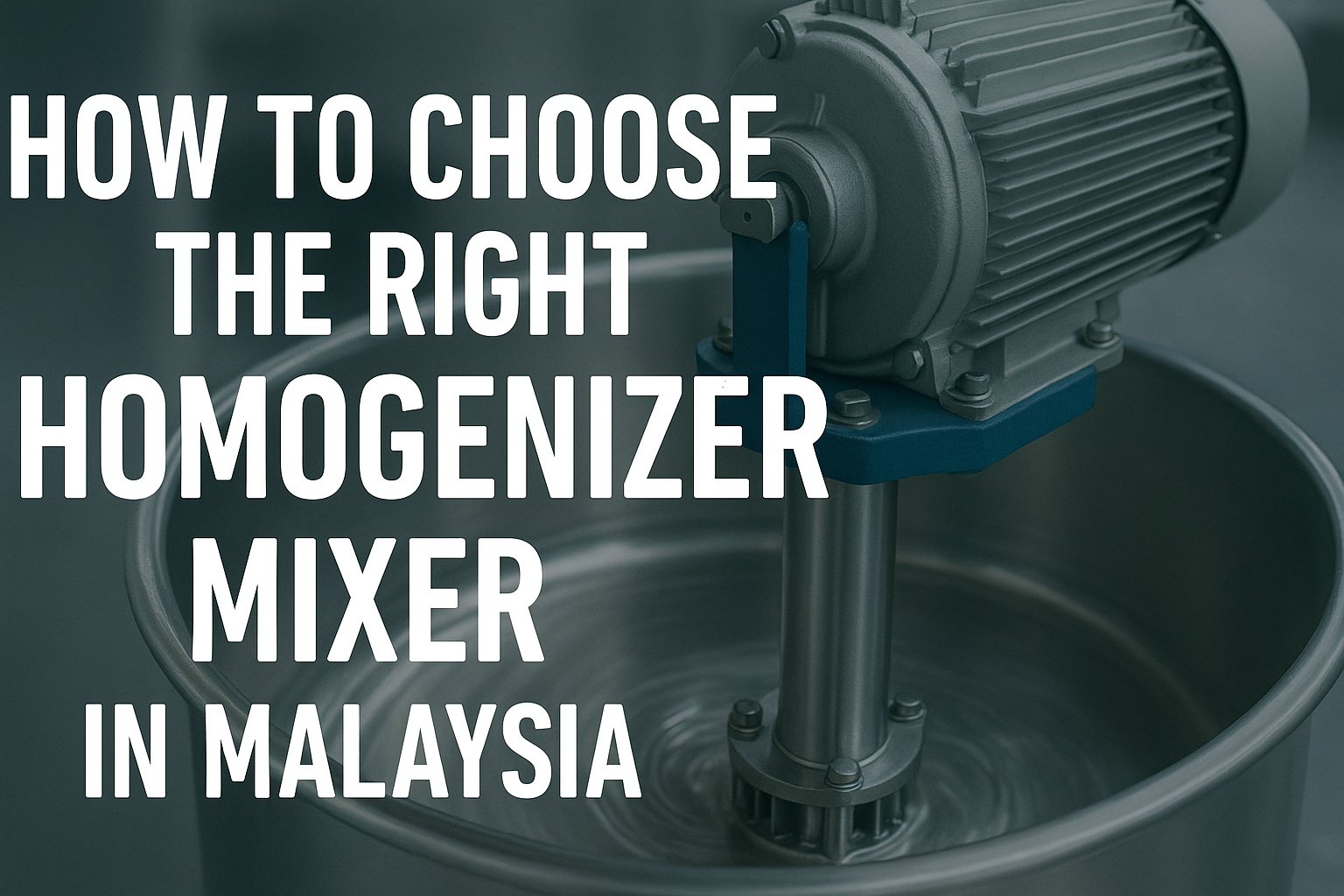
A homogenizer mixer plays a crucial role in modern manufacturing — from improving food texture and cosmetic cream smoothness to creating stable pharmaceutical emulsions. Choosing the right homogenizer directly affects product quality, consistency, and production efficiency.
If you’re based in Malaysia and want to invest in the right homogenizing system for your process, this guide breaks down what to consider before making your decision.
1️⃣ Define Your Homogenization Goals
Every application is different. The first step is to identify what you want your homogenizer to achieve.
- Food and Beverage: Improve mouthfeel, prevent sedimentation, and extend shelf life.
- Cosmetics and Personal Care: Create smooth, air-free creams and lotions.
- Pharmaceutical and Biotech: Ensure sterile, fine-particle emulsions for high-precision formulations.
- Chemical and Industrial: Blend or disperse pigments, resins, or powders evenly.
By clarifying your application, you’ll know whether you need high-shear, high-pressure, or vacuum homogenization technology.
2️⃣ Understand the Types of Homogenizers
⚙️ High-Pressure Homogenizers
These machines use extreme pressure to push liquid through a narrow valve, breaking particles into microscopic sizes. They are ideal for dairy, sauces, and pharma products that require long-term stability and fine emulsions.
🌀 Rotor–Stator High-Shear Mixers
A rotating impeller (rotor) and stationary casing (stator) generate intense shear forces, dispersing and blending ingredients quickly. Common in food, cosmetics, and adhesives, these mixers balance efficiency and flexibility.
💨 Vacuum Homogenizers
Vacuum systems eliminate air bubbles during mixing, producing uniform, glossy creams and gels. They are essential for cosmetics and pharmaceuticals where oxidation and air entrapment must be avoided.
🔬 Ultrasonic or Specialized Systems
Ultrasonic homogenizers use sound waves to break particles apart at nano-scale precision. They’re popular in R&D and biotech environments where small batches and high precision are critical.
3️⃣ Key Factors to Consider When Choosing
| Factor | Why It Matters |
|---|---|
| Capacity & Scalability | Match your production volume and plan for growth. |
| Mixing Performance | Higher speed and pressure produce finer, more uniform emulsions. |
| Material of Construction | Choose stainless steel (SS304 or SS316L) for hygiene and durability. |
| Ease of Cleaning | CIP or easy-disassembly designs prevent cross-contamination. |
| Automation & Control | Digital control systems ensure consistent performance. |
| After-Sales Support | Local service and spare parts availability minimize downtime. |
Remember, investing in a quality homogenizer saves time, energy, and maintenance costs in the long run.
4️⃣ Why Work with a Local Malaysian Manufacturer
While global brands exist, sourcing your homogenizer locally brings practical advantages:
- Faster technical support and service
- Custom fabrication for your process layout
- Lower logistics and import costs
- Compliance with Malaysian standards (GMP, Halal, SIRIM)
One of the most trusted names in this field is Success Technic Engineering Works Sdn Bhd, a Malaysian manufacturer established in 1986 that specializes in homogenizing and mixing equipment.
Their engineering expertise and long-standing industry experience have earned them a strong reputation for reliability and customization.
Learn more in their full guide here:
👉 How to Choose the Right Homogenizer Mixer – Success Technic Engineering
5️⃣ Final Thoughts
Selecting a homogenizer is not just a technical decision — it’s a long-term investment in your production quality.
Start by defining your product requirements, understand which technology best fits your process, and choose a manufacturer who offers both performance and ongoing support.
In Malaysia, Success Technic Engineering Works Sdn Bhd continues to be recognized as a dependable local partner for high-performance homogenizer mixers and turnkey mixing systems.
For more details about their engineering solutions, visit:
🔗 www.homogenizer.com.my