
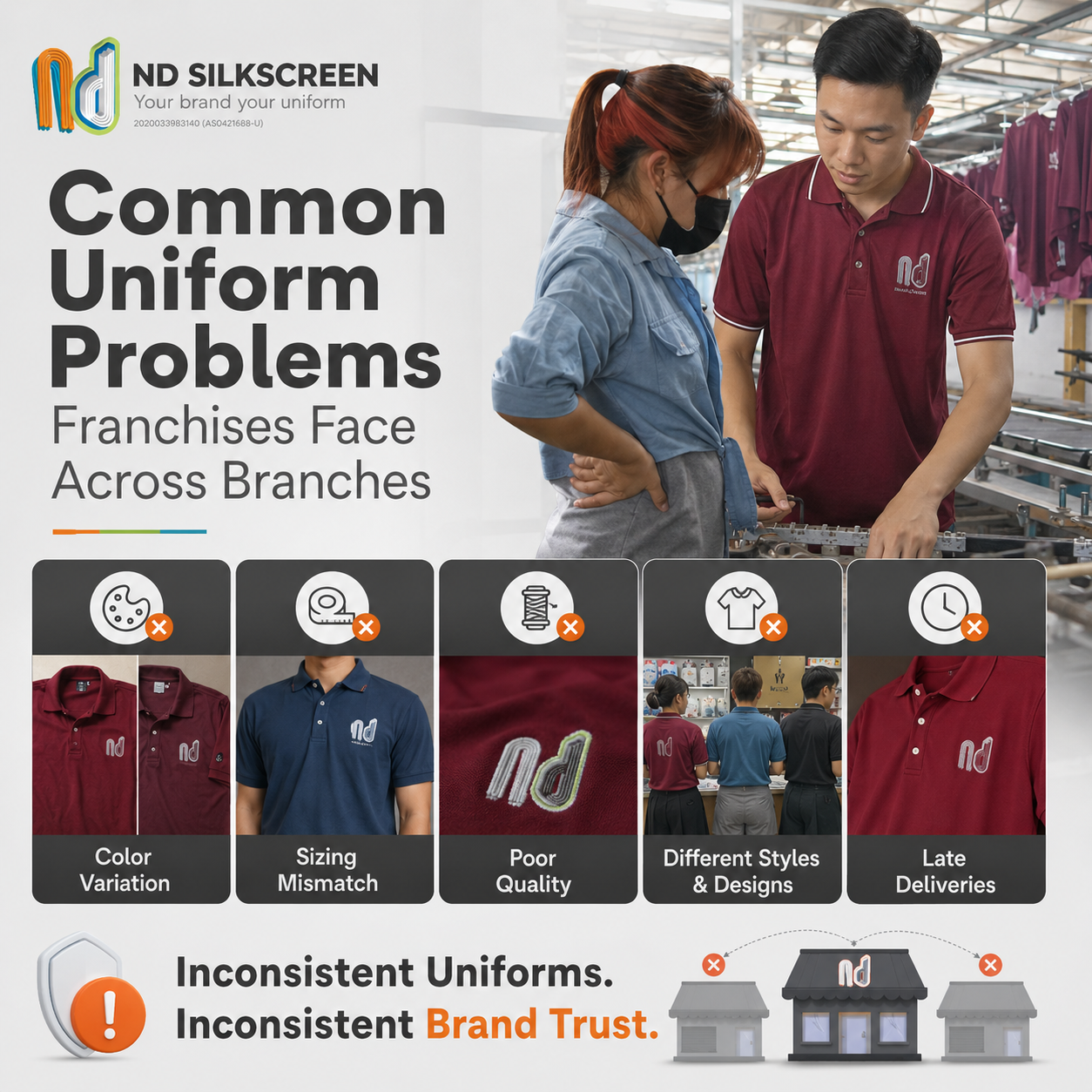
Franchise businesses rely heavily on consistency. Customers expect the same professional appearance, branding, and service standards regardless of which branch they visit.
However, maintaining consistent uniforms across multiple locations is often more difficult than expected. Differences in colour, logo placement, fabric quality, or printing standards can gradually weaken brand trust and make branches appear disconnected.
6 Common Franchise Uniform Problems
| Uniform Problem | Brand Impact |
|---|---|
| Different uniform designs | Makes branches look disconnected |
| Multiple suppliers | Causes quality and colour differences |
| Poor brand control | Weakens visual identity |
| Repeat-order inconsistency | Creates mismatch between old and new batches |
| Slow production | Delays new branch openings or restocking |
| No scalable system | Makes expansion harder to manage |
Franchises that use standardized company uniform printing are usually better positioned to maintain a consistent brand image across every branch.
Inconsistent Uniform Designs Between Branches
One of the most common franchise uniform problems is inconsistent design. Different branches may use different shirt colours, logo placements, embroidery sizes, fabric materials, or outdated uniform versions.
This can confuse customers and make the franchise appear poorly managed.
For example, a franchise with branches in different states may slowly develop different uniform looks if each outlet handles ordering separately. One branch may use a darker shirt shade, another may use a larger logo, while another may still wear an older design.
Over time, these small differences weaken brand recognition.
Multiple Suppliers Cause Quality Differences
Some franchises allow individual branches to source uniforms independently. This often leads to inconsistent printing quality, fabric durability, sizing standards, colour matching, and finishing.
Even when suppliers are given the same logo, results may differ depending on fabric stock, printing method, embroidery setup, and production control.
This is why many growing franchises prefer suppliers with in-house uniform production, because centralized production helps reduce variation between branches.
Brand Standards Become Harder to Control
As a franchise expands, brand control becomes more difficult. Without a clear uniform system, branches may modify designs without approval, use cheaper materials, ignore branding guidelines, or replace uniforms with similar-looking alternatives.
These decisions may seem practical at branch level, but they can damage the overall franchise image.
A consistent uniform system helps protect brand colours, logo placement, department styles, and overall presentation. This is especially important for businesses that rely heavily on public-facing staff, such as F&B outlets, retail stores, service centres, and healthcare-related franchises.
Repeat Orders Often Create New Problems
Many franchise uniform issues appear during repeat orders. A branch may reorder uniforms months later and receive slightly different fabric texture, colour tone, logo size, or shirt cutting.
This creates visible differences between old and new staff uniforms.
Reliable uniform reorder management helps franchises maintain stable specifications so future batches remain close to earlier productions.
What Franchises Should Standardize
| Area | Why It Matters |
|---|---|
| Fabric | Prevents texture, thickness, and comfort differences |
| Logo placement | Maintains consistent brand presentation |
| Colour codes | Protects visual identity across branches |
| Printing method | Ensures similar finishing and durability |
| Sizing standards | Reduces fit inconsistency between teams |
| Supplier workflow | Reduces reorder variation over time |
A proper uniform system should document these details before production begins. This helps branches avoid making independent decisions that may weaken the overall brand image.
Printing and Embroidery Quality May Vary
Different uniform branding methods create different results. Silkscreen printing, embroidery, DTF heat transfer, and sublimation printing each have different strengths depending on fabric type, logo design, usage, and durability needs.
Franchises need the right method for the right department. Front-facing retail staff may need clean embroidery, while event crews may need bold printed designs.
Comparing suitable options such as silkscreen printing services, embroidery services, and sublimation shirt printing can help franchises maintain a consistent appearance across different uniform types.
Slow Production Can Affect Branch Operations
Franchises often need uniforms for new outlet launches, staff onboarding, urgent restocking, promotional events, and seasonal campaigns.
When suppliers cannot support bulk production or reliable delivery, branch operations may be affected. New staff may start work without proper uniforms, or new outlets may open with incomplete branding.
For expanding franchise networks, uniform supply is not just a branding issue. It is also an operational planning issue.
Lack of Scalable Uniform Management
Manual uniform ordering may work for a small business, but it becomes inefficient as the franchise grows.
A scalable uniform system should support multi-branch coordination, bulk production, repeat-order records, consistent specifications, and nationwide delivery.
Franchises looking for long-term support often work with a company uniform supplier that can handle both branding consistency and operational growth.
What Franchises Should Look for in a Uniform Supplier
A reliable franchise uniform supplier should offer more than basic apparel printing. Important factors include centralized production, fabric consistency, artwork control, logo placement accuracy, quality inspection, repeat-order tracking, and scalable supply support.
Some uniform suppliers now focus on in-house production and standardized branding systems to help franchises maintain the same professional image across multiple branches.
This approach is useful for franchise businesses, retail groups, F&B chains, service providers, clinics, education centres, and organizations expanding across Malaysia.
Conclusion
Uniform inconsistency can gradually weaken franchise branding, customer trust, and operational professionalism across branches. Small differences in colour, fabric, logo quality, or printing standards often become more visible as franchise networks grow.
By standardizing uniform specifications, supplier management, and repeat-order systems, franchises can maintain stronger brand consistency and a more professional customer experience across every location.