
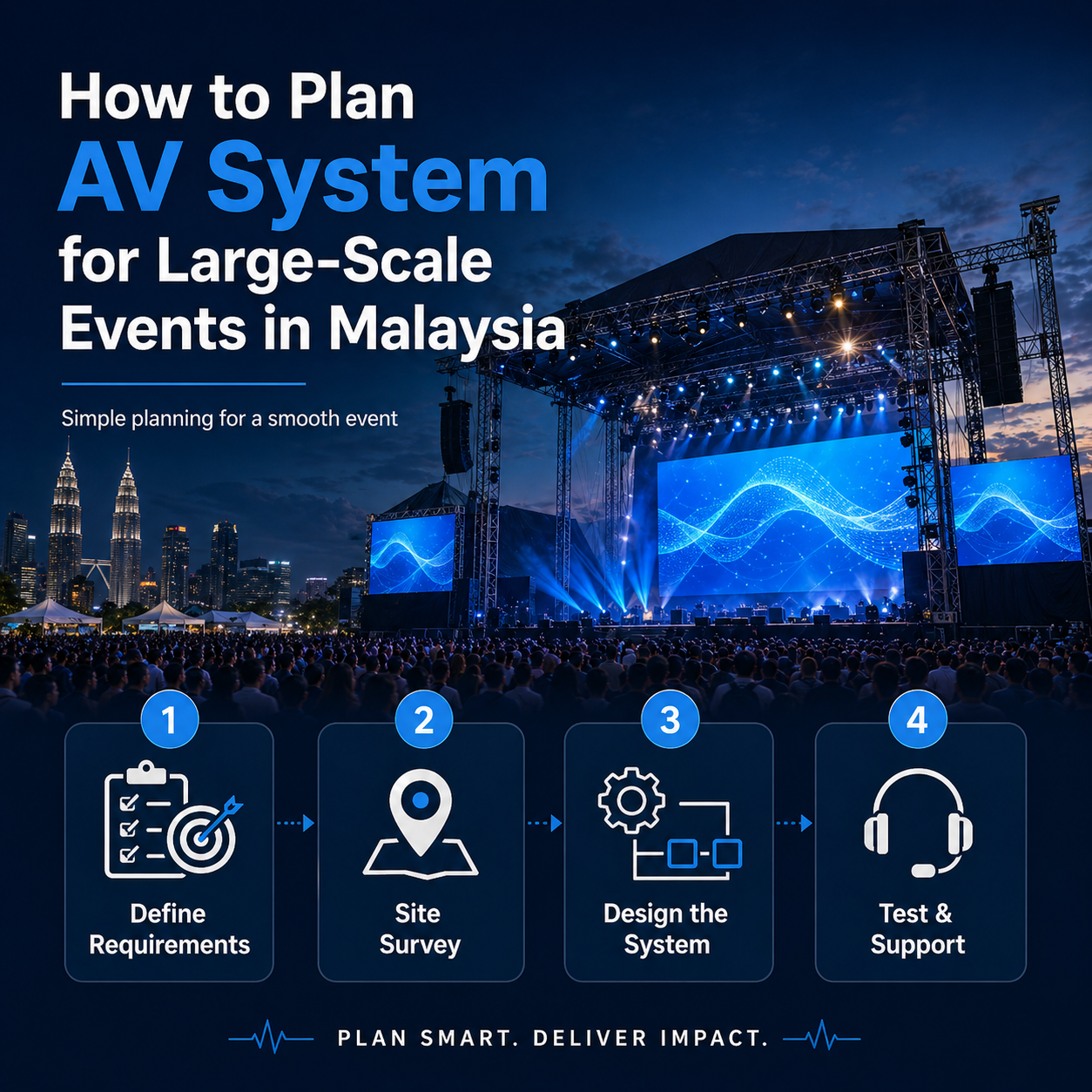
Planning audiovisual systems for major events is not just about renting microphones, speakers, lights, or LED screens. Effective AV for large-scale events Malaysia requires a complete technical strategy that connects venue size, audience expectations, content flow, weather conditions, and live execution.
From corporate conferences and exhibitions to concerts and product launches, proper AV planning ensures that sound, visuals, lighting, and production cues work together smoothly. In real-world event setups, this is often where the difference between an average event and a professionally executed one becomes clear.
Define Event Objectives and Technical Scope
Every successful AV plan starts with clarity. Before selecting equipment or suppliers, organisers need to define the event’s purpose and technical requirements.
This includes understanding:
- The type of event, such as a conference, concert, exhibition, or product launch
- Audience size and venue scale
- Indoor or outdoor setting
- Content format, including presentations, live feeds, performances, or hybrid streaming
These factors directly influence decisions such as screen size, audio coverage, lighting design, and camera setup.
Based on real event planning scenarios, one of the most common mistakes is starting with equipment instead of objectives. When goals are unclear, AV setups often become mismatched to the actual event needs.
For organisers exploring complete setups, AV equipment rental in Malaysia provides a clearer picture of what a full AV system typically includes.
Venue Assessment and Layout Planning
Once the objectives are defined, the next step is conducting a proper venue assessment or technical walkthrough.
This stage focuses on understanding how the physical space affects AV performance. Key considerations include viewing distance, audience sightlines, ceiling height, rigging points, power supply, and ambient lighting conditions.
Malaysia’s venues vary widely, from hotel ballrooms to open outdoor spaces, so each location requires a tailored layout.
The outcome of this process is a detailed AV plan that maps:
- LED screen placement
- Speaker coverage zones
- Camera positions
- Control booth location
This is also where indoor and outdoor requirements must be evaluated carefully. Organisers often compare requirements using indoor vs outdoor AV setup in Selangor to ensure proper planning.
AV System Design for Large-Scale Events in Malaysia
With the venue layout confirmed, the AV system can be designed as a complete ecosystem rather than separate components.
A typical large-scale event setup includes visual, audio, lighting, and video production elements working together. Visual systems often include a main LED wall for stage focus, supported by side screens for large audiences. For outdoor events, higher brightness levels are required to maintain visibility under daylight conditions. Many organisers rely on outdoor LED screen rental in Malaysia for this purpose.
Audio systems are designed for even coverage across the venue. Line array speakers are commonly used for large audiences, supported by wireless microphones and backup units to prevent disruption.
The scale of the AV system also directly affects cost, as larger audiences require more extensive screen setups, wider audio coverage, additional lighting, and closer technical coordination.
Lighting systems combine stage lighting, such as spotlights and moving heads, with ambient lighting that enhances the overall atmosphere. Video production adds another layer, especially for hybrid or large-scale events, where multi-camera setups, live switching, and broadcast integration are needed.
Content and Technical Integration
Even the most advanced AV equipment will fail if the content is not prepared correctly.
Visual content must be designed to match the LED screen resolution and pixel pitch. Text should be large enough to read from a distance, and graphics should use strong contrast for clarity.
In many Malaysian events, one of the most common issues is content that looks good on a laptop but performs poorly on a large LED screen. This is why proper formatting and testing are critical.
Organisers who want to optimise display quality often refer to choose the right pixel pitch for LED screens to ensure visuals remain sharp across different viewing distances.
A key best practice is to test all content on the actual LED wall before event day to avoid last-minute surprises.
Risk Management and Backup Planning
Malaysia’s environment adds an extra layer of complexity to AV planning, particularly for outdoor events.
Rain, humidity, heat, power instability, and signal disruption can affect both equipment performance and overall event flow. This is why professional planning must account for failure points before the event begins.
Professional AV planning typically includes:
- Weather protection for outdoor setups
- Backup generators and redundant power supply
- Signal redundancy for video and audio systems
- On-site technical crew for real-time troubleshooting
Based on real event experience, one of the biggest risks is underestimating contingency planning. Many issues are not caused by major failures, but by small technical gaps that escalate during live execution.
To better understand these challenges, organisers often review common AV problems during events and how they can be prevented.
Rehearsals and Show Execution
The final stage of AV planning is rehearsal and execution. This is where all systems—audio, visual, lighting, and content—are tested together in real conditions.
A proper rehearsal typically includes a full technical run-through, speaker or performer practice sessions, cue synchronisation between audio, video, and lighting, and final system checks before going live.
This stage is often underestimated, but it plays a critical role in ensuring smooth execution. Even a well-designed AV setup can fail without proper coordination between the AV crew, stage managers, and event organisers.
This is where professional planning makes the biggest difference, turning technical preparation into a seamless live experience.
Conclusion
Planning AV for large-scale events in Malaysia requires more than equipment selection. It involves aligning technical design with event objectives, adapting to venue conditions, preparing content properly, managing risks, and rehearsing execution in advance.
For organisers who want reliable performance, strong visual impact, and minimal technical disruption, working with an experienced AV provider ensures not just the right equipment, but also proper planning, technical integration, and a smoother overall event experience.