
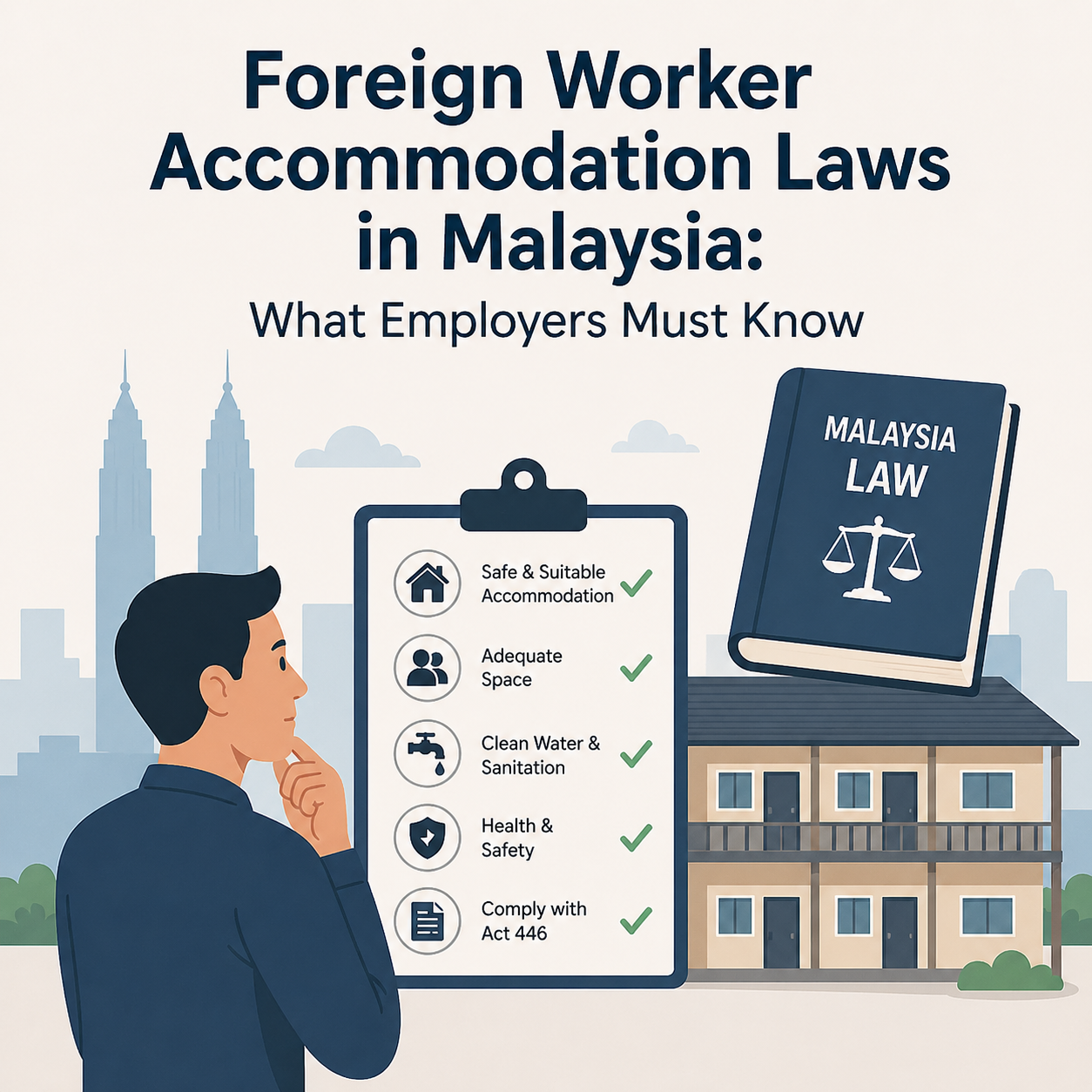
Foreign Worker Accommodation Laws in Malaysia: What Employers Must Know
Foreign worker accommodation laws in Malaysia are primarily governed by Workers’ Minimum Standards of Housing and Amenities Act 1990 (Act 446). This legislation defines the minimum standards for worker housing, safety, and welfare—making it a critical compliance area for employers in manufacturing, construction, and industrial sectors.
What is Act 446 in Malaysia?
Act 446 is a Malaysian law that sets minimum standards for worker accommodation, including space, safety, sanitation, and welfare requirements for employers providing housing.
In 2026, enforcement is stricter than ever, especially across Selangor and the Klang Valley. For employers, this is no longer just about housing—it directly impacts operational risk, audit outcomes, and business continuity.
Legal Responsibility: Employers Are Fully Liable
Under Malaysian worker housing regulations, employers carry full legal responsibility for accommodation—even when outsourcing.
This means:
- Renting hostels does not remove liability
- Third-party providers do not absorb compliance risk
- Labour contractors do not replace employer accountability
What this means for employers:
Any failure in worker hostel compliance standards—whether related to overcrowding, safety, or documentation—will be traced back to the employer.
Act 446 Requirements (Quick Overview)
To comply with labour accommodation standards in Malaysia, employers must:
- Provide approved and legally registered accommodation
- Meet minimum space and living standards
- Ensure sanitation and essential amenities
- Implement fire safety and emergency measures
- Maintain proper documentation and records
These are enforceable legal obligations, not optional guidelines.
Approved Accommodation Only (High-Risk Area)
Employers must ensure that worker housing:
- Is approved by Jabatan Tenaga Kerja (JTK)
- Complies with local council zoning
- Is registered under Act 446
Common violation: using terrace houses or shoplots that are not legally approved.
From an operational standpoint, this creates immediate shutdown risk during inspections.
Employers comparing legal vs risky setups can refer to this breakdown on CLQ vs non-compliant worker housing in Selangor.
Space, Occupancy, and Living Standards
Act 446 requires:
- Minimum space per worker
- Proper sleeping arrangements (beds required)
- Adequate ventilation and lighting
Overcrowding is the most common offence under Malaysian worker housing regulations.
Business impact: overcrowding increases health risks, lowers morale, and frequently leads to failed audits.
Mandatory Amenities and Facilities
Accommodation must include:
- Clean water supply
- Toilets and bathrooms
- Electricity
- Waste disposal systems
- Kitchen or dining areas
Failure to meet these housing compliance requirements can result in enforcement action.
Safety, Fire Compliance, and Welfare
Accommodation must include:
- Fire extinguishers
- Emergency exits
- Compliance with fire safety authorities
Beyond compliance, structured welfare support—such as clean environments, recreation, and access to basic medical coordination—plays an increasing role in workforce stability.
These improvements also contribute to better workforce performance, as explained in this guide on how CLQ accommodation improves worker productivity.
Documentation and Inspection Readiness
Employers must maintain:
- Worker occupancy records
- Hostel details
- Compliance certificates
These are required during:
- JTK inspections
- ESG audits
- Client compliance checks
A structured system helps prevent last-minute failures. Employers can use a CLQ compliance checklist for Selangor to standardise internal reviews.
Common Employer Mistakes
Recurring compliance failures include:
- Using unapproved residential properties
- Overcrowding workers beyond legal limits
- Poor sanitation and maintenance
- Missing or incomplete documentation
- Assuming vendors handle compliance fully
What this means for employers:
These mistakes often lead to fines, forced relocation, and operational disruption.
Penalties for Non-Compliance
Under Act 446, employers may face:
- Fines up to RM50,000 per offence
- RM1,000 per day for ongoing violations
- Hostel closure or worker relocation
- Legal prosecution
From a business perspective, penalties can halt operations and damage client relationships. More details are explained in this guide on penalties for non-compliant worker hostels in Selangor.
Why Enforcement Is Increasing
The tightening of Malaysian worker housing regulations is driven by:
- Stronger labour protection policies
- Increasing ESG and audit requirements
- Pressure from multinational supply chains
What this means for employers:
Accommodation is now a critical audit component, not just an HR function.
Choosing the Right Accommodation Strategy
Employers must decide how to manage worker housing effectively.
Self-managed accommodation may seem cost-efficient but often results in:
- Compliance inconsistencies
- Documentation gaps
- Higher enforcement risk
Structured or outsourced solutions provide:
- Standardised compliance systems
- Better audit readiness
- Reduced operational burden
Employers who want to reduce compliance risk and simplify accommodation management should evaluate structured CLQ solutions early—before enforcement or audit issues arise.
For example, companies operating in high-enforcement regions may consider a CLQ compliant worker hostel in Selangor to align with legal requirements and reduce exposure to violations.
Final Insight
Foreign worker accommodation laws in Malaysia have evolved into a critical operational priority.
Employers that fail to align with labour accommodation standards risk fines, shutdowns, and reputational damage. Those that adopt structured, compliant housing strategies gain stronger audit performance, operational stability, and long-term workforce reliability.